News Story
Preparing for the New Road Safety Strategy
News Story
Preparing for the New Road Safety Strategy
As the government rolls out a new Road Safety Strategy, it’s important for anyone whose business keeps vehicles on the road to familiarise themselves not just with the guidance but the theory behind it.
The Road Safety Strategy has set targets for 2035, and experience tells us that the specific guidance will likely evolve over the next decade. However, by paying attention to the intent, savvy fleet managers will be able to stay ahead of the curve, potentially reducing the outlay needed to comply significantly over that time.
Goals of the Road Safety Strategy
On average, over the course of 2024, four lives were lost each day on British roads, with others seriously injured. The government’s response is this strategy, designed to reduce KSI (Killed or Seriously Injured) over a decade.
Currently, the government has five consultancies active. These are aimed at:
- Mandating appropriate vehicle safety technologies
- Adjusting penalties for motoring offences in order to achieve better road safety
- The introduction of a minimum learning period for learner drivers
- Mandatory eyesight testing for older drivers
- Improvements to moped and motorcycle training, testing, and licensing
Of these, the first is the most important to business owners and managers who have to keep vehicles on the road.
Vehicle Safety Technologies
The government intends to make the fitting of 18 safety technologies mandatory for specific vehicle categories. These include:
- Advanced Distraction Warnings (ADW)
- Blind Spot Information Systems (BSIS)
- Drowsiness and Attention Warnings (DAW)
- Direct Vision (DIV)
- Emergency Braking for Cyclists (EBC)
- Emergency Braking for Pedestrians (EBP)
- Emergency Braking for Vehicles (EBV)
- Event Data Recorders (EDR)
- Emergency Lane Keeping Systems (ELKS)
- Emergency Stop Signals (ESS)
- Intelligent Speed Assistance (ISA)
- Moving-Off Information Systems (MOIS)
- Reversing Motion Awareness (RMA)
- Tyre Pressure Monitoring Systems (TPMS)
Not all of these are applicable to all categories of vehicle, at least in current expectations. So, how can you ensure you conform?
Existing Solutions
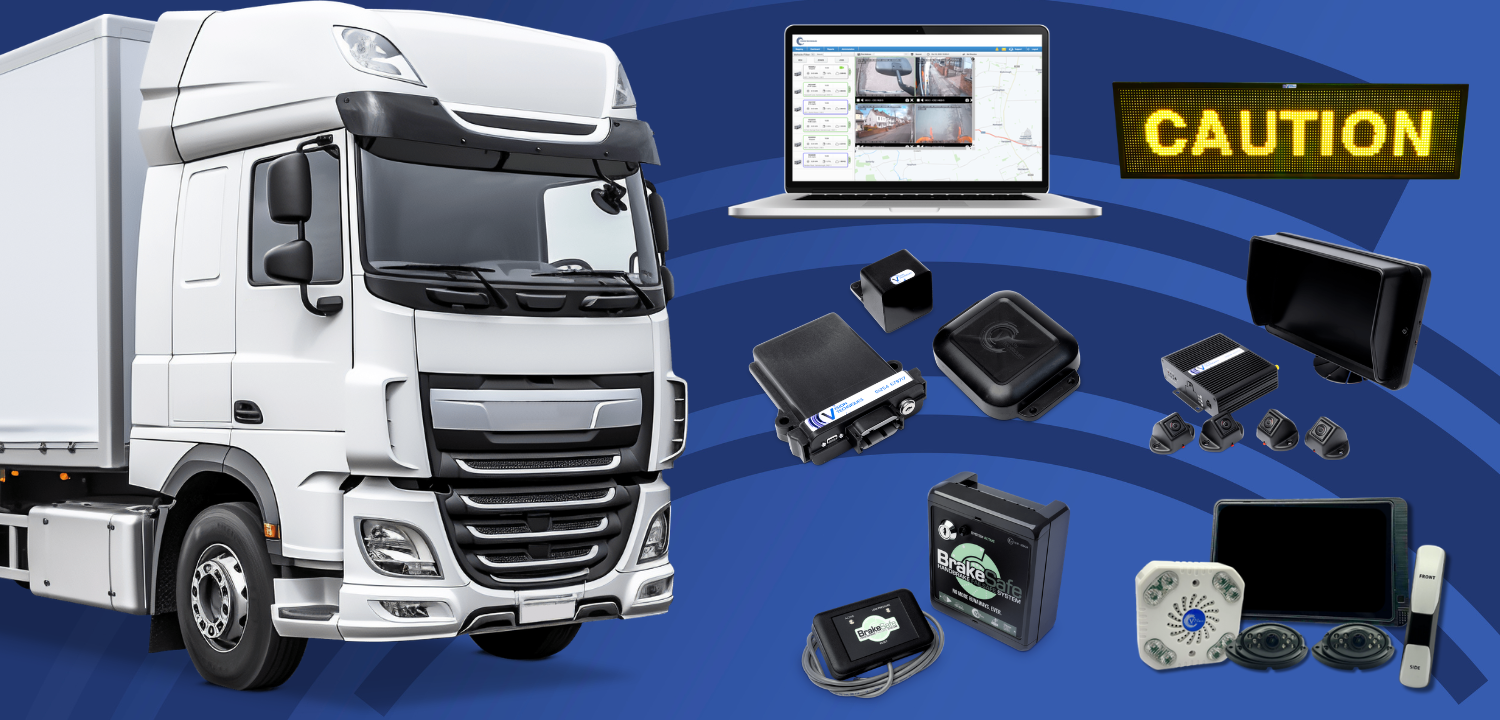
Here at Vision Techniques we already have a range of existing solutions which you can invest in now.
For a BSIS, our VT 3D 360 Overview System is designed to eliminate blind spots, providing a driver with all the information they need. This also functions as RMA technology, aiding the driver with motion awareness when reversing.
As it’s required in London, we already offer a solution for the Direct Vision requirement in our Progressive Safe System.
We also offer multiple different braking systems, including the VT Brakesafe System and the VT Banksman Auto Braking Radar System.
Being able to monitor and record events can be key, especially in questions of liability. Our range of recording devices offers several options depending on your specific needs. We support this with VT Connect, our fleet telematics software.
The specification for Emergency Stop Signals requires a “light-signaling function… to other road users to the rear of the vehicle”. This could be further augmented through use of the VT Lightboard.
We also offer a MOIS solution in the VT MOIS PDS, which comes as part of our Progressive Safe System.
The ADW and DAW systems monitor driver alertness, and activate to keep them from being distracted or to alert them that they should rest respectively.
If you’d like to start getting these systems fitted, or if you have any other questions, please contact us directly through the form below. We’ll be happy to help.
More News
View All News


Head Office
Vision Techniques (UK) Ltd
Phoenix House,
Phoenix Park,
Blakewater Road
Blackburn,
Lancashire, BB1 5SJ
Contact
t: 01254 679 717
e: info@vision-techniques.com